

Accident to the Robin DR400 registered F-GBAX on 15/10/2024 at Clamensane-les-Trois-Fontaines mountain airstrip
Runway overrun on mountain airstrip, bank strike, rupture of nose gear, damage to main landing gear and propeller
This is a courtesy translation by the BEA of the Final Report on the Safety Investigation. As accurate as the translation may be, the original text in French is the work of reference.
Note: the following information is principally based on the pilot’s statement. This information has not been independently validated by the BEA.
1. HISTORY OF THE FLIGHT
The pilot took off shortly before 09:00 from Château-Arnoux - Saint-Auban aerodrome and carried out in succession, three landings on Super Dévoluy mountain airstrip, two landings on Mens mountain airstrip and one landing on Montmeilleur, Grand Terrus and Colombe d’Eyguians mountain airstrips.
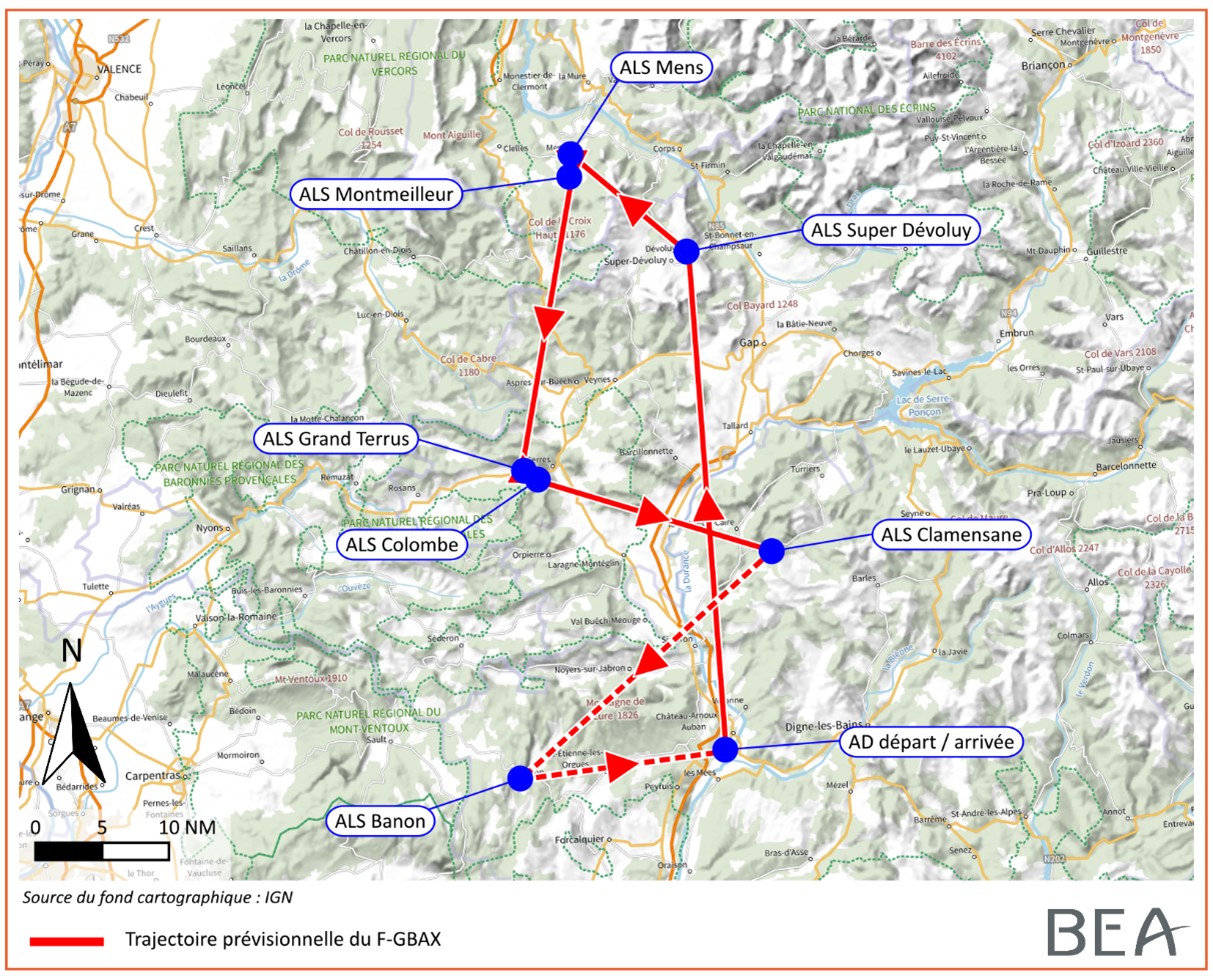
Figure 1: pilot’s planned circuit
The pilot then headed to Clamensane mountain airstrip where she planned to carry out two landings. During the first landing, the aeroplane slid during the braking phase and did not sufficiently decelerate. As after the end of the runway there was a substantial cant, the pilot decided to direct the aeroplane towards the bank situated on the far west side of the flat ground after the ascending slope. She was not able to stop the aeroplane which collided with the bank. Under the effect of the deceleration, her head hit the instrument panel. She evacuated the aircraft without difficulty however.
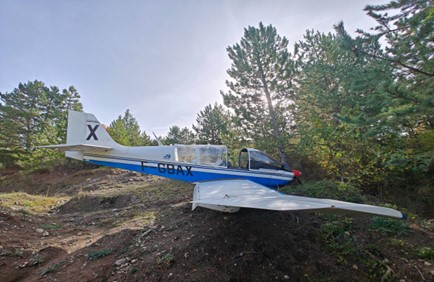
Figure 2: final position of aeroplane (source: pilot)
2. ADDITIONAL INFORMATION
2.1 Pilot information
The 43-year-old pilot held a PPL along with a wheel mountain rating, both valid at the time of the accident. She had logged more than 600 flight hours. She had flown more than 10 h in the previous 90 days, including 6 h in the previous month. She obtained the mountain rating in 2015 and regularly carried out landings on the region’s mountain airstrips on board F-GBAX. The pilot estimated that she had carried out a hundred or so landings on Clamensane mountain airstrip since obtaining the mountain rating.
2.2 Aircraft information
The DR400/180 R registered F-GBAX was equipped with a “small-pitch” propeller and a manual brake handle. Each seat was equipped with a lap belt and shoulder straps. Given the year of manufacture of the aircraft, the regulations did not require that the seats be equipped with “three-point” restraint systems.
2.3 Mountain airstrip information
Clamensane mountain airstrip has a grass runway measuring 350 m x 20 m with a convex lengthwise profile. The airstrip sheet, published by the AFPM and used by the pilot, indicates that the first 200 m of the runway has an ascending slope of 12% and that the flat ground after the ascending slope, measuring 150 m long, has a descending slope of 1%.
2.4 Meteorological information
The meteorological conditions estimated by Météo-France on and in the vicinity of Clamensane mountain airstrip was as follows:
• calm, anticyclonic weather;
• calm wind, no gusts or turbulence;
• visibility and humidity:
o before 10:30: very humid to saturated air near the surface, presence of mist or fog banks that could wet the ground,
o between 10:30 and 10:45, mist and fog dissipating rapidly, visibility increasing to more than 5 km,
o between 10:45 and 11:00, visibility increasing to more than or equal to 8 km.
2.5 Pilot’s statement
The pilot indicated that, given the heavy rainfall in recent weeks in the region , she had paid particular attention to any signs of dampness during the overhead reconnaissance. She thought that the condition of the mountain airstrips she had landed on before arriving at Clamensane had reinforced her belief during the reconnaissance, that the runway was as usable as the previous ones. She felt that she had been over-confident and had not taken sufficient account of the threat posed by the local humidity that had prevailed since the evening of the previous day. She thought that a reconnaissance in both directions, with different lighting, would probably have enabled her to see that the grass was wet.
She added that her speed on final was 110 km/h and that she made contact with the ground at a speed not exceeding 115 km/h. She indicated she touched down at the beginning of the runway and immediately began braking. She said she realized even before reaching the flat ground after the ascending slope that the aeroplane was not decelerating sufficiently, and decided to direct the aircraft to the left in order to benefit from a natural stopping barrier in case it was impossible to stop the aeroplane before the end of the runway.
She believed she may have been less vigilant after her successful landing on Grand Terrus mountain airstrip, which she considers to be the most difficult. She added that she had not felt tired on arriving at Clamensane, having made a full stop of around ten minutes to fifteen minutes on the Montmeilleur mountain airstrip.
The pilot explained that once the aeroplane had been stopped by the bank, she evacuated the aircraft without difficulty and then contacted the president of the flying club. She explained to him that she was unhurt and that she could hear a regular “beep-beep” coming from the aircraft. The president of the flying club told her that the emergency locator transmitter had probably been activated and that it had to be deactivated. The pilot then deactivated the transmitter while the president of the flying club called 191 to prevent a rescue operation from being initiated.
3. SAFETY LESSONS
By its very nature, a mountain airstrip is a restrictive take-off and/or landing area. Each mountain airstrip has its own specific characteristics (dimensions, topographical environment, circuit, etc.) which require the pilot to have a differentiated situational awareness specific to each one. While some characteristics of a mountain airstrip can be considered permanent, such as the runway profile, others, such as aerology and sunlight, change over the course of a day. The surface condition is also an evolving parameter, requiring the pilot to make a specific assessment each time the mountain airstrip is used.
Only meticulous preparation of the flight, taking into account all the parameters likely to affect both landing and take-off performance, and heightened vigilance during reconnaissance, will enable the pilot to make a decision adapted to the actual current situation. A successive reconnaissance in two opposite directions will allow the pilot to observe the runway in a different light. This will enable the pilot to refine his observation and obtain additional information on the runway's actual surface condition.
4. MEASURES TAKEN BY FLYING CLUB
Although the pilot was not injured, the flying club decided to install three-point restraint systems on the aircraft, replacing the original lap belts, in order to preventively increase occupant safety in the event of another safety occurrence.
April 2025