
Serious incident to the ATR 72 registered F-ORVS operated by Air Tahiti on 04/04/2022 at Atuona
Non-stabilised approach, windshear, opposite dual inputs, hard landing, balked landing
At the request of the crew of the ATR72 operated by Air Tahiti which were ready to take off for Hiva-Oa-Atuona airport, the AFIS officer at Nuku-Hiva airport where the crew were on a stop, indicated that the upper wind at the destination airport was from the east with a surface wind showing significant variations in direction and strength. The crew planned to carry out an RNP approach to runway 20 due to the reported tailwind component on preferred runway 02.
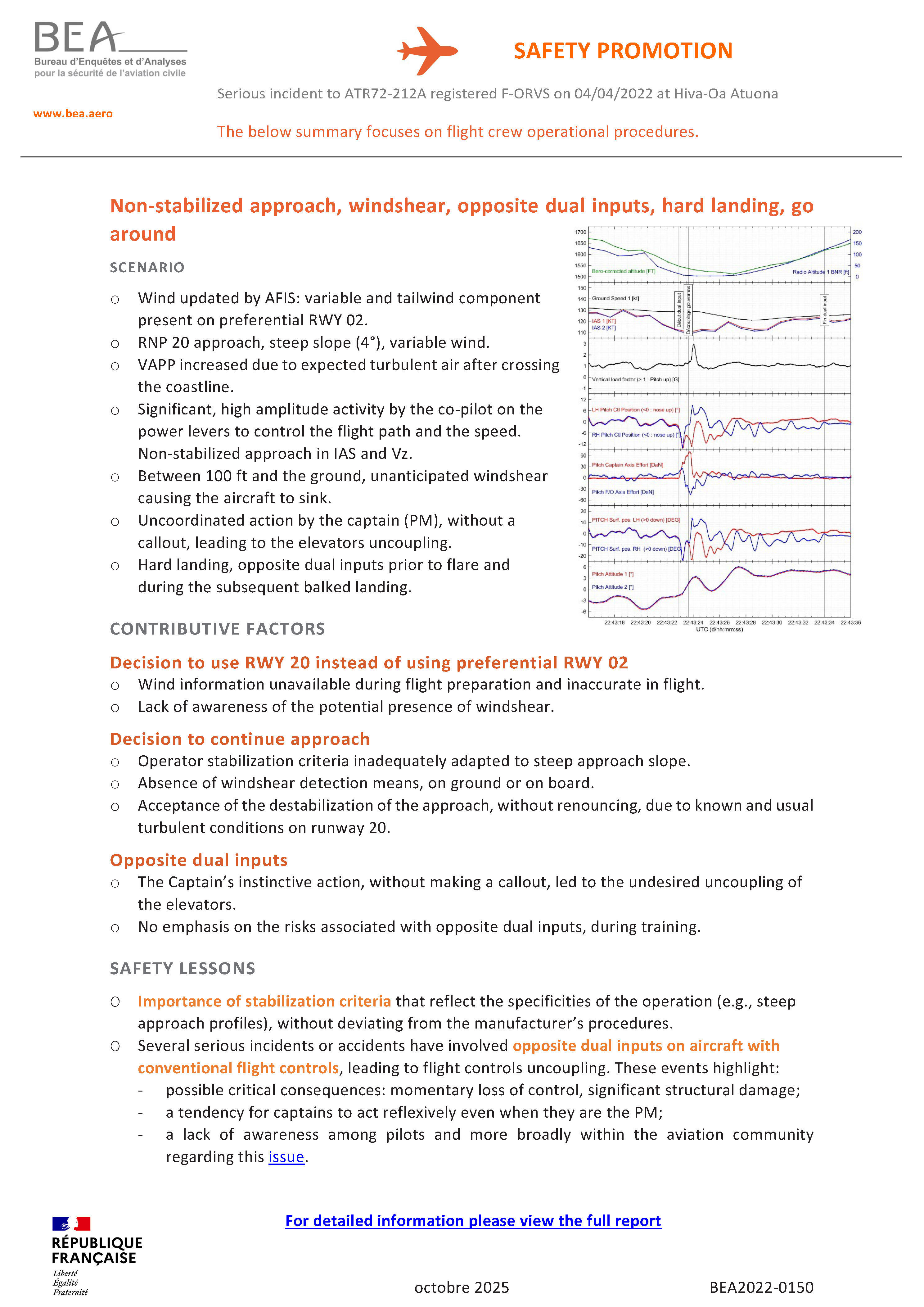
En route, the crew contacted the Hiva-Oa-Atuona AFIS officer several times to obtain up to date wind information. The AFIS officer specified that the direction was still variable and the tailwind component on runway 02 still present. The crew confirmed their choice of landing on runway 20. On the RNP20 approach, the crew chose to increase the approach speed given the turbulent air after passing the coastline and on the lee side of the terrain. The co-pilot, PF at this point, managed to hold the flight path by means of many large-amplitude inputs on the power levers. However, despite these inputs, there were significant Vz and IAS deviations with respect to the stabilisation criteria. The crew perceived this situation as usual in these wind conditions for this approach.
At 200 ft agl, to reduce the speed, the co-pilot reduced the engine power to flight idle. On flying through 90 ft agl, the aeroplane’s IAS suddenly decreased due to windshear and the rate of descent increased. This variation led to the captain asking the co-pilot to increase power as the aeroplane was flying over the threshold of runway 20. More time was required to counter the windshear effects starting from flight idle than that needed with steady-state speed. When he perceived that the aeroplane was sinking, the captain (PM) made a nose-up input on the control column, at the same time as the co-pilot. This reflex action, which was not called out, surprised the co-pilot who probably thought that his nose-up input had been inappropriate. This led him to make an opposite input. The captain increased the nose-up load applied to his control column which led to the elevators uncoupling.
Less than one second later, the wheels of the main landing gear touched down hard on the runway. The aeroplane bounced and the captain called out a go-around. He then informed the co-pilot that he was taking the controls. At the same time, the “Pitch disconnect” Master Warning was activated. The co-pilot and the captain continued to make opposite dual inputs for 11 s.
After an analysis of the situation and coordination, the crew decided to carry out a visual approach to runway 02. The landing proceeded normally.
The BEA issues two safety recommendations:
- Recommendations FRAN-2025-005 & FRAN-2025-006 / Airport meteorological service levels
The BEA recommends that:
- whereas the limited reliable and accurate meteorological information available when preparing flights, and subsequently in flight;
- whereas uncertified, more or less reliable or inaccurate meteorological information represents a risk for the approach;
- whereas the increased risks when flying in and out of certain airports, notably due to their specific aerological characteristics;
- whereas the applicable regulatory provisions with respect to the transmission of meteorological information to aircraft pilots by the ATS services;
- whereas the regulatory provisions applicable to aircraft operators concerning flight preparation, in particular the access to destination and alternate airports;
- whereas better-quality meteorological information could be used to design IFR approach paths better suited to local conditions;
the DGAC, in coordination with Météo-France, ensure that on the various airports in French Polynesia, an adequate meteorological service level is provided, in order that inter-island commercial flights are carried out safely and in accordance with requirements;
pending the upgrading of the meteorological service on French Polynesia airports, the DAC ensure that crews who receive meteorological parameters from facilities not certified by Météo-France are fully informed that the values of these parameters have not been validated.
The recommendations are being processed.
___________________________________________________________________
Note: in accordance with the provisions of Article 17.3 of Regulation No 996/2010 of the European Parliament and of the Council of 20 October 2010 on the investigation and prevention of accidents and incidents in civil aviation, a safety recommendation in no case creates a presumption of fault or liability in an accident, serious incident or incident. The recipients of safety recommendations report to the issuing authority in charge of safety investigations, on the measures taken or being studied for their implementation, as provided for in Article 18 of the aforementioned regulation.
- Click here to download the "safety digest" as a pdf file.