Dual inputs: an underestimated phenomenon on aeroplanes with conventional flight controls
Dual inputs, or simultaneous inputs, are when both pilots perform simultaneous, sometimes opposing, actions on the flight controls. For a long time, this phenomenon was considered to be specific to aeroplanes equipped with independent sidesticks. On these aeroplanes, both the difficulty of visually perceiving the action of the other pilot and the absence of force feedback in the sidestick led to the provision of an aural and visual warning indicating dual inputs by both pilots. In an analysis published in 2006, Airbus distinguishes three types of dual inputs:
“Spurious” actions, the consequences of which are generally marginal, given their limited duration and amplitude.
“Comfort" actions, consisting of brief interventions to modify the aeroplane’s flight path. These actions generally have a minor impact on flight safety, unless the PF, surprised by the aeroplane’s behaviour and unaware of the reason for it, tries to counter the PM's actions.
“Instinctive" actions in response to an unexpected event. Airbus observed that these actions were more significant in terms of deflection and duration.
A number of occurrences in recent years have shown that the phenomenon of dual inputs also exists on aeroplanes with conventional flight controls, and that the consequences can be significant.
1. Destabilized approach, missed approach, difficulties controlling flight path during the go-around
In 2024, the BEA published the investigation report on the serious incident involving the Boeing 777 registered F-GSQJ operated by Air France on 5 May 2022 at Paris-Charles de Gaulle. During the ILS approach to runway 26L, without external visual references, in manual operation and with the FD activated, the co-pilot (PF) expressed his surprise about the aeroplane’s bank angle and flew a missed approach. At this time, the aeroplane was 0.2 dots to the left of the localizer with a bank angle of 6°. Surprised by the high pitch rate resulting from the co-pilot's actions, the captain (PM) made an opposing nose-down input. The two pilots then simultaneously made inputs on the controls for 53 s. The pitch controls were desynchronized for 12 s due to the opposing forces exceeding the mechanism's activation threshold (difference of 23 kg). Two brief episodes of roll desynchronization were also observed. The desynchronization of roll and pitch controls is reversible on the Boeing 777; they automatically synchronize again as soon as the opposing forces fall below the mechanism's activation threshold. After recovering control of the flight path, the crew carried out a new approach to runway 27R without further incident.
The BEA has also opened an investigation into the serious incident involving the ATR 72 registered F-ORVS operated by Air Tahiti on 4 April 2022 at Hiva Oa Atuana (French Polynesia). Following a non-stabilized RNP approach to runway 20, in turbulent conditions, the aeroplane encountered windshear. Faced with the imminence of a hard touchdown, the captain (PM) made inputs on the controls at the same time as the co-pilot (PF). The dual inputs lasted around ten seconds, and continued after the crew had begun a go-around, and after the captain had called out that he was taking the controls. On this type of aeroplane, disconnection occurs if simultaneous and opposing forces are applied to the sticks (between 50 and 55 daN applied to each stick). This desynchronization is irreversible in flight on an ATR. After an analysis of the situation and coordination, the crew decided to carry out a visual approach to runway 02.
3. In-flight upset, inadvertent pitch uncoupling, and continued operation with serious damage
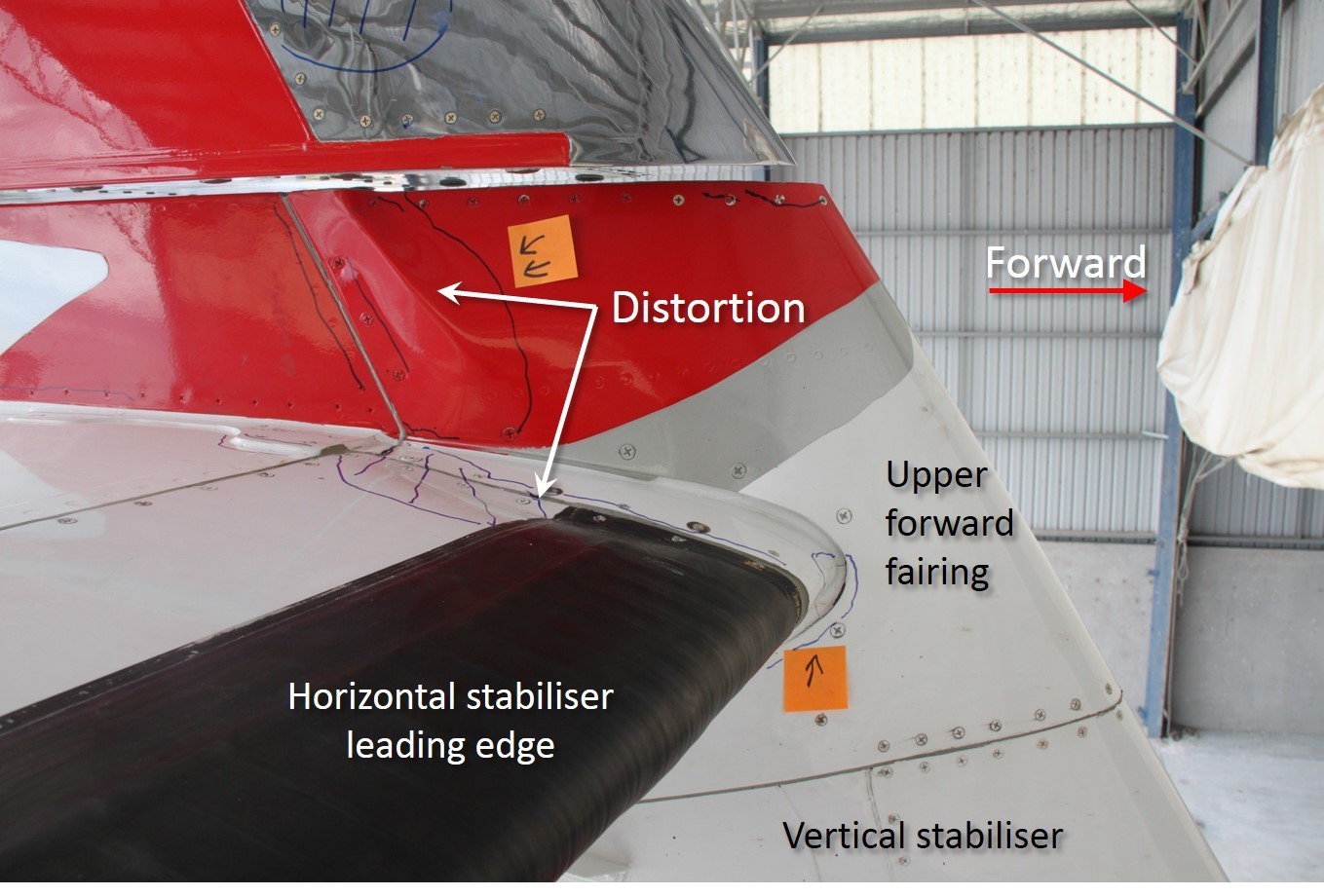
In the past, the BEA was an accredited representative to the Australian Investigation Authority (ATSB) on the accident involving the ATR 72 registered VH-FVR operated by Virgin Australia Regional Airlines (VARA) on 20 February 2014, in descent towards Sydney. The aeroplane encountered windshear that resulted in a rapid increase in the indicated airspeed. The co-pilot (PF) reduced engine power and made nose-up inputs to reduce speed. The captain, concerned that they were exceeding the maximum operating speed (VMO), took hold of the controls without alerting of his intent. The co-pilot, unaware that the captain was making control inputs, made an opposing pitch-down input which activated the pitch uncoupling mechanism. The opposing dual inputs resulted in a manoeuvre that exceeded the aircraft's load limit, causing substantial damage to the horizontal and vertical stabilisers. A cabin crew member who did not have her seatbelt fastened, was injured.
In all three cases, the captain was initially the PM and intervened in the face of danger deemed imminent. These are instinctive actions. On these aeroplanes with conventional controls, the prevention of dual inputs relies solely on the principle of calling out the taking of the controls. This principle remains fragile in dynamic and stressful situations. The aeroplanes concerned generally have no visual or aural warnings to alert the crew that they are making dual inputs on the flight controls.
These occurrences are notable because the dual inputs exceeded the activation threshold of the flight control desynchronization mechanism. This mechanism was designed to prevent the risk of a control channel jamming, e.g. due to icing or an object (FOD). The operating logic of these mechanisms differs according to aeroplane type. For example, on the ATR, once the controls are desynchronized, each stick controls the elevator on its own side, this elevator being in two parts on either side of the fuselage. Continuing the dual inputs is likely to result in imprecise or even unstable control of the flight path. What's more, at high speeds, the structural loads become substantial, even critical. The operating logic is different on the Boeing 777: the position of the control surfaces in pitch (or roll) is calculated using the arithmetic mean of the positions of the control columns (or wheels).
The investigations into the above occurrences revealed that pilots are generally unaware of the consequences of dual inputs on the activation of this mechanism. This is likely to compromise their ability to recognize the situation and react appropriately.
Few occurrences where dual inputs led to flight control desynchronization have been reported by operators to the manufacturers concerned or to the competent authorities. Prior to these occurrences, few operators had set up a system for monitoring this phenomenon through systematic analysis of flight parameters. Following the serious incident involving F-GSQJ, the operator set up systematic monitoring of dual inputs on its Boeing fleet of 777s and 787s, and retrospectively studied the fleet’s flight data from the previous five years in order to identify similar events. The purpose of this monitoring was to detect simultaneous loads on the pitch axis in manual operation for more than one second. No other desynchronizion of the controls was detected. On the other hand, dual inputs were detected in manual operation, during specific flight phases (rotation or flare): the movement was initiated by the PF and followed by a brief action on the controls by the PM. In 2022 for example, for the Boeing 777 fleet, the number of recorded occurrences corresponds to a rate of 0.4 per 1,000 flights. By way of comparison, the rate of reported occurrences on this operator's Airbus fleet is 0.44 per 1,000 flights. The values are therefore comparable, but the proportion of pilot reports is not. The activation of the “Dual input” warning on the Airbus fleet encourages the crew to report the occurrence. The BEA considers that dual input situations should be monitored with the same attention, whether the aircraft is equipped with conventional or fly-by-wire flight controls. In addition to not being fully aware of the possible consequences, it is likely that the frequency of this phenomenon is underestimated by the community.